A commercial property can look impressive from the curb and still leave the most valuable questions unanswered. Commercial flyover essentials address that gap by showing how a site connects to roads, neighboring businesses, parking, infrastructure, and the wider market. For brokers, developers, property managers, and investors, that context can make a listing easier to understand before the first site visit.
A flyover is not simply a drone flying high over a building. It is a planned visual sequence designed to communicate scale, location, access, and momentum. When the footage is intentional and legally captured, it becomes a practical sales and communication asset for commercial listings, land opportunities, construction updates, leasing campaigns, and investor presentations.
What a Commercial Flyover Should Accomplish
The strongest commercial flyovers answer the questions a buyer or tenant is already asking: Where is the property? How do people get to it? What surrounds it? How large is the site? What has changed since the last update?
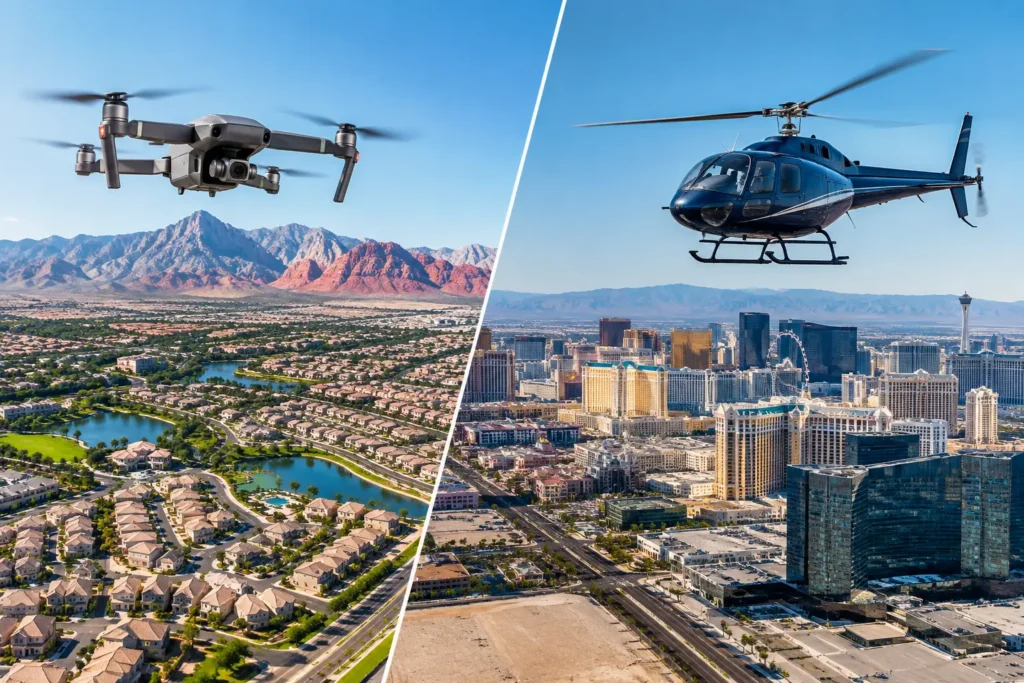
Ground-level photography remains essential for exterior finishes, tenant spaces, interiors, and details. Aerial imagery adds the geographic story that ground photography cannot provide. A warehouse may be close to a major transportation corridor. A retail center may benefit from strong road visibility and nearby rooftops. A land parcel may be easier to evaluate once viewers can see its boundaries, terrain, adjacent development, and approach routes.
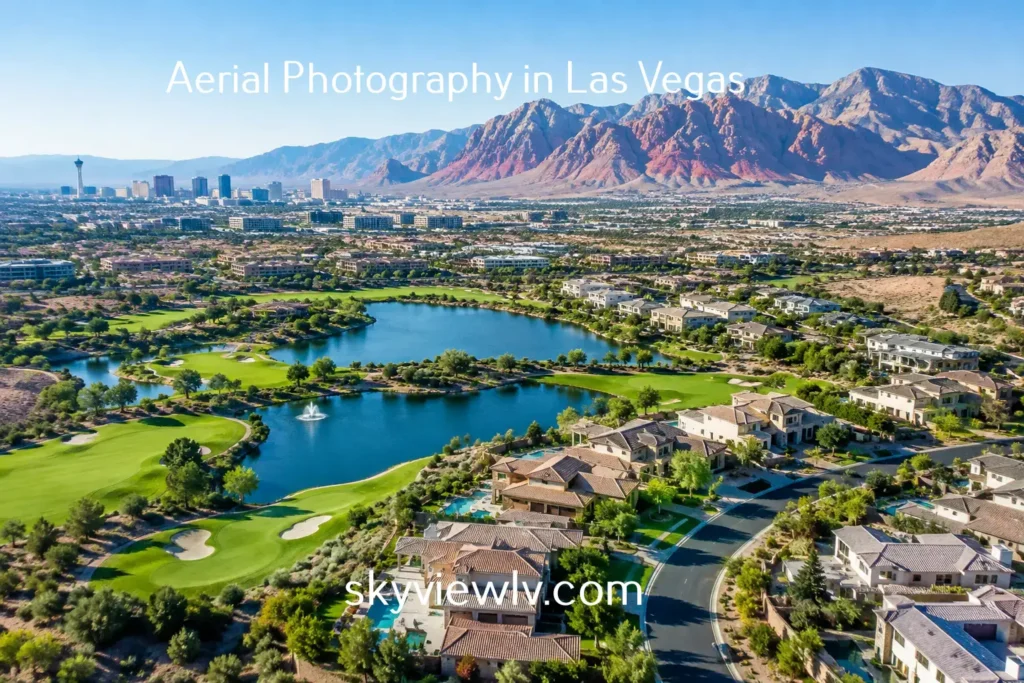
That difference matters in the Las Vegas Valley, where properties can sit near fast-moving arterial roads, master-planned communities, resort corridors, industrial zones, and large undeveloped tracts. Aerial media helps viewers place the asset in its real operating environment rather than guessing from a map pin.
Commercial Flyover Essentials That Add Marketing Value
A useful flyover begins with the outcome, not the aircraft. Before a pilot plans a route, the project team should decide what the media needs to prove. The objective for a stabilized multifamily asset differs from that of raw land, a construction site, or a retail redevelopment.
A Clear Establishing View
Every commercial sequence needs orientation. A broad opening frame can establish the property within its immediate neighborhood, then transition to a closer view of the building, parcel, or active jobsite. This gives viewers a sense of scale before they focus on features.
Altitude should serve the property. Flying too high can make an asset look small and disconnected; flying too low can obscure road access and the surrounding context. The right balance depends on parcel size, building height, nearby obstacles, and the story the client needs to tell.
Access, Visibility, and Surrounding Context
For many commercial assets, the approach is part of the value. Aerial perspectives can show entrance points, drive aisles, parking fields, loading areas, nearby intersections, and proximity to key corridors. They can also reveal visibility from surrounding roads without relying on vague claims.
Context must be handled carefully. The goal is to show real relationships, not to make a property appear closer to a destination or freeway than it is. Thoughtful framing gives prospective buyers, tenants, and investors useful information while maintaining credibility.
Site Features That Support the Deal
The visual plan should identify features that matter to the intended audience. For industrial properties, that may include truck circulation, trailer storage, dock positions, rail adjacency, or available yard space. For retail, it may be frontage, signage exposure, parking, neighboring traffic generators, and tenant mix. For land, it may be grading progress, utility corridors, drainage features, access points, and surrounding development patterns.
A good flyover does not attempt to show everything in one pass. It prioritizes site conditions that support the marketing message and captures them from angles that are clear on mobile screens and presentation displays.
Purposeful Movement and Clean Editing
Cinematic movement should feel controlled, not distracting. Slow reveals, measured lateral passes, and smooth pull-backs often communicate more value than rapid turns or dramatic maneuvers. The viewer should be able to absorb the property, not work to follow the camera.
Editing matters as much. A short, well-paced commercial reel can be more effective than several minutes of repetitive footage. Depending on the campaign, the final package may include a landscape video for presentations, vertical cuts for social media, still aerial photographs for offering materials, and selected progress images for stakeholder updates.
Compliance Is Part of the Deliverable
Commercial drone work is a flight operation before it is a photo shoot. That distinction is especially relevant in Southern Nevada, where controlled airspace near Harry Reid International Airport, Nellis Air Force Base, and other restricted areas can affect when, where, and how a flight may occur.
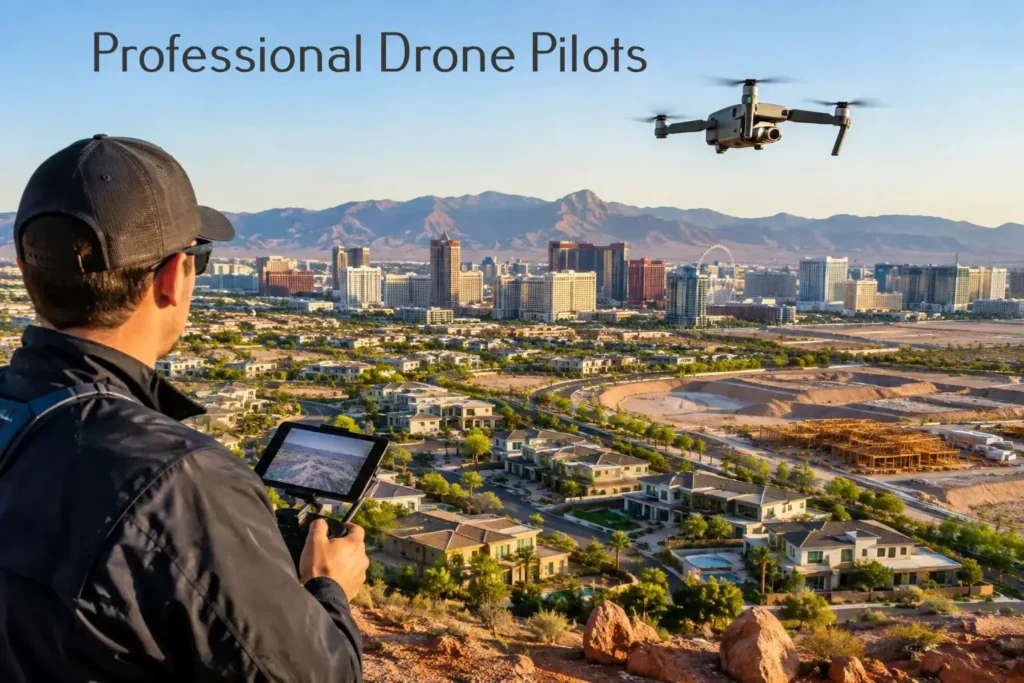
FAA-certified drone pilots evaluate airspace, weather, site hazards, operating restrictions, and the requested shot list before launch. A professional provider also carries appropriate liability insurance and follows the authorization process required for the location. These steps are not paperwork added after the fact. They determine whether a planned capture can be completed safely, legally, and on schedule.
Clients should be cautious about assuming a drone can launch anywhere simply because the site is private property. Property ownership does not eliminate federal airspace requirements. Flight approvals, operational limitations, and local conditions may change the visual plan, particularly near airports or sensitive facilities.
That does not mean premium aerial media is out of reach for complex sites. It means the crew needs to plan early. At Sky View LV, FAA-certified drone pilots coordinate logistics before production, so clients are not left to manage airspace questions, equipment issues, or avoidable rescheduling on their own.
Plan the Shoot Around the Audience
The same building can need very different aerial coverage depending on who will see it. A broker marketing a property for lease may need a concise video focused on visibility, ingress, parking, and surrounding retail. An investor evaluating an acquisition may need high-resolution stills documenting roof condition, site layout, adjacencies, and operational context. A development team may need recurring views from consistent positions to track construction milestones.
Timing also changes the result. Early morning can provide long shadows that define architecture, while midday may offer a cleaner view of parking layouts and site boundaries. Sunset can create a strong campaign image for hospitality, retail, or high-profile mixed-use assets, but it may not be the best choice for documenting construction detail. The best time is the one that supports the decision the images need to help make.
For active job sites, coordination is critical. Aerial captures should avoid interrupting crews, document the correct phase of work, and account for cranes, equipment, temporary fencing, and changing site conditions. Consistent flight paths and camera angles make monthly or quarterly updates more useful, as stakeholders can directly compare progress.
Avoid the Most Common Flyover Mistakes
The most common error is treating aerial footage as decoration. Beautiful views alone will not strengthen a commercial campaign if they fail to explain the asset. Another mistake is collecting only video when still photography is needed for brochures, proposals, and listing platforms.
Over-editing can also work against the property. Fast cuts, excessive music-driven motion, or heavy color effects may feel impressive briefly but can reduce clarity. Commercial buyers and decision-makers need polished visuals, but they also need an honest read of the site.
Finally, do not wait until the listing goes live to arrange aerial production. Airspace review, weather windows, tenant coordination, and site access can all affect scheduling. Building flyover planning into the marketing timeline gives the team more options and reduces last-minute compromises.
Turn One Flight Into a Usable Asset Library
The return on aerial production improves when a single planned flight supports multiple deliverables. A commercial project may need hero imagery for a listing, a short property overview video, detail stills for offering memorandums, vertical clips for digital campaigns, and construction documentation for internal reporting.
This does not require capturing random footage. It requires a shot plan that considers where the finished assets will appear. A short vertical clip needs different framing than a widescreen investor presentation. High-resolution stills need deliberate composition and appropriate capture settings, not frames pulled from video.
Commercial flyovers work best when they are treated as evidence with visual impact: proof of access, proof of scale, proof of progress, and proof that a property belongs in the conversation. Start with the question your audience needs answered, then build the flight around the clearest possible view.