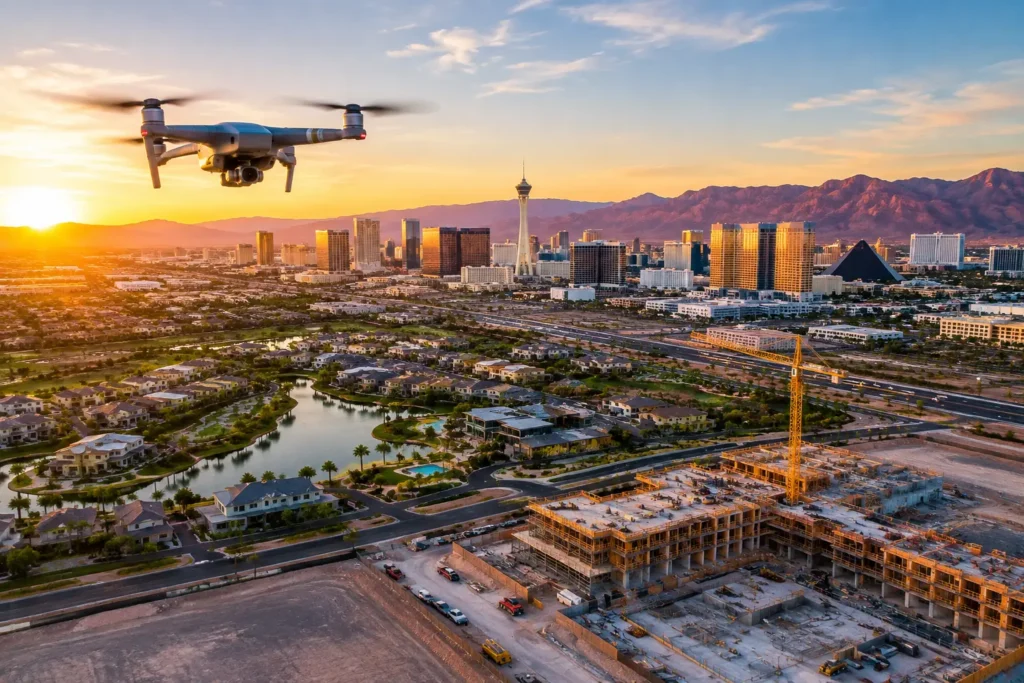
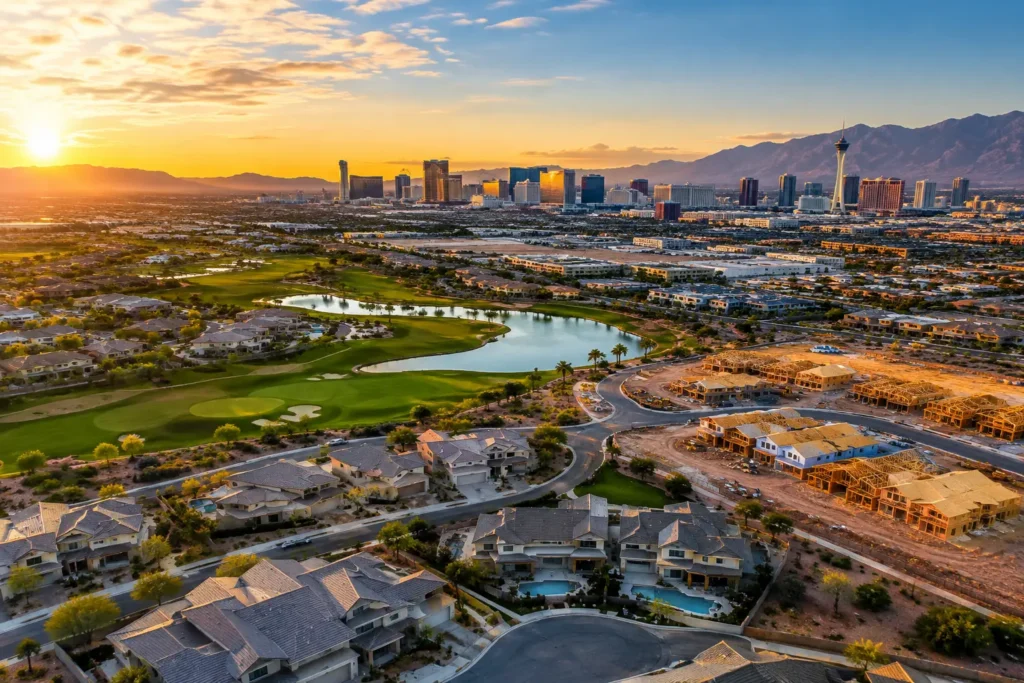
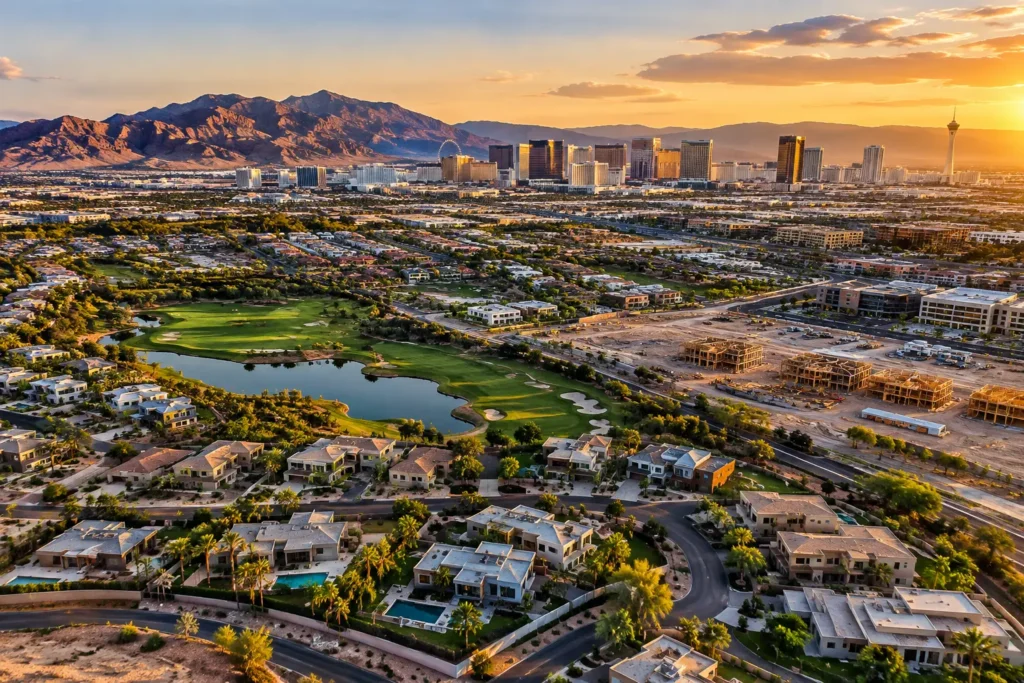
A listing can showcase a beautiful kitchen, a finished lobby, or a well-designed floor plan, yet still leave a buyer asking the most important question: where is this property in relation to everything else? Drone videography answers that question in seconds. It shows the approach, the setting, the scale, and the surrounding advantages that ground-level media cannot fully capture.
For Las Vegas real estate—commercial property, land, and active development sites—that broader perspective is not an extra. It is often the difference between a generic listing package and a visual presentation that gives prospects a reason to stop, watch, and request more information.
Why Drone Videography Performs Beyond Still Photos
Aerial photography is excellent for a hero image, but video adds movement and sequence. A carefully planned flight can begin with a wide view of a neighborhood or development, reveal the property in context, and then transition toward the details that matter to a buyer, tenant, investor, or project stakeholder. The result is a more complete story in less time.
For a residential listing, that story may focus on a corner lot, mountain views, pool space, nearby parks, and access to major corridors. For commercial property, it may show road frontage, ingress and egress, parking capacity, adjacent businesses, and proximity to the Strip, resort corridors, warehouses, or major transportation routes. For raw land, video can establish acreage, topography, surrounding development, and future potential far more clearly than a static image alone.
Motion also creates a stronger sense of scale. Aerial video can illustrate the relationship between a building and its site, or between a site and the larger Las Vegas market. That is particularly useful when the asset itself is difficult to understand from the ground, such as a multi-building campus, an industrial facility, a golf course community, a large estate, or a construction project.
The best aerial footage doesn’t just fly high. It follows a purpose. Every shot should answer a question the intended audience is likely to have.
What a Professional Aerial Video Should Show
The right shot list depends on the property and the audience. A luxury home video should not be paced or framed like an investor presentation for an industrial parcel. Still, professional drone videography generally works best when it combines broad context with specific visual proof.
A residential project may benefit from an elevated establishing shot, a smooth orbit around the home, a reveal of the backyard or view corridor, and a route that connects the property to nearby lifestyle amenities. The goal is to make the home feel like part of a desirable experience, not just a collection of rooms.
For commercial real estate, the emphasis often shifts to access and utility. Aerial video can document loading areas, visibility from key roads, neighboring anchors, traffic patterns, building footprint, rooftop equipment, and the surrounding business environment. These views help brokers and decision-makers quickly communicate the property’s practical value, especially when stakeholders are reviewing it from another city or state.
Construction teams and developers use aerial footage differently. Regular flyovers can create an accurate visual record of site progress, help communicate milestones to investors and ownership groups, and provide a clear perspective for planning discussions. Video is not a substitute for formal surveying or engineering documentation, but it can be an effective operational communication tool when produced consistently and organized by project phase.
Las Vegas Airspace Changes the Production Plan
Las Vegas is a spectacular market for aerial media, but it is not a place for casual commercial flight. Much of the valley is affected by controlled or sensitive airspace, including areas around Harry Reid International Airport and Nellis Air Force Base. Flight planning, location review, authorization requirements, altitude limits, and operational conditions must all be addressed before a drone takes off.
That is why a professional operator matters. FAA-certified drone pilots understand that a compelling shot is only useful if it can be captured legally and safely. They evaluate the location, determine whether airspace authorization is required, plan an appropriate flight path, assess site hazards, and ensure proper insurance coverage.
The trade-off is straightforward: a professional production may require advanced coordination, particularly near restricted areas or for larger commercial sites. In return, clients avoid the cost and risk of attempting a flight without the required training, approvals, equipment, or documentation. A missed shot, an unsafe flight, or footage that cannot be used because it was captured improperly is far more expensive than planning correctly from the start.
Drone Video Is a Marketing Asset, Not a Novelty
Aerial footage earns its place in a marketing package when it is edited for the platform and the audience. A cinematic property film can support a listing presentation, a social media campaign, a brokerage website, an investor deck, a property landing page, or a digital advertising effort. Short clips can quickly capture attention, while a longer edit can provide the context serious prospects need before scheduling a tour.
The footage must also align with the property’s brand. An upscale custom home may call for slow, elegant movement and a polished color grade. A land listing may need direct, informative visuals that clearly show boundaries, roads, utilities, and neighboring projects. A construction update may prioritize clarity over drama, with repeatable angles that make progress visible month after month.
Professional editing is where much of that value is created. Raw aerial clips are rarely ready for public use. They need to be selected, stabilized where appropriate, color-corrected, paced, and assembled into a sequence that feels intentional. Music, graphics, labels, and property information can be useful, but only when they serve the message rather than distract from it.
When Drone Videography Delivers the Strongest Return
Not every property needs a full aerial production. A small condo without an exterior story, for example, may benefit more from excellent interior photography and a concise neighborhood clip than from an extensive flight plan. The best approach depends on the property’s differentiators, the expected price point, the buyer profile, and the channels where the media will appear.
Drone video tends to have the greatest impact when location, land, views, access, scale, or surroundings influence value. It is especially effective for luxury homes, gated communities, resort-adjacent assets, acreage, commercial buildings, multifamily properties, industrial sites, hospitality venues, and development opportunities.
It also helps when a property is competing in a crowded category. Buyers may scroll past dozens of similar listings, but a well-produced aerial reveal can quickly establish why one opportunity deserves a closer look. For commercial and investment audiences, it can help reduce some of the uncertainty that comes with reviewing a site remotely.
How to Prepare for an Aerial Video Shoot
Clients get better footage when the property is camera-ready. Exterior areas should be clean, landscaping maintained, vehicles moved when possible, and any construction activities coordinated with the filming window. If a site has specific features that should be highlighted, such as an access point, view line, amenity, lot boundary, or future phase, share that information during the planning conversation.
Timing matters as well. Morning and late-afternoon light often creates more depth and visual warmth than the harsh midday sun. However, the best time depends on the property’s orientation, the season, the weather, wind conditions, and the specific shots required. A warehouse facade, a west-facing backyard, and a mountain-view estate may each call for a different schedule.
It is also smart to identify the final deliverables before filming begins. A vertical social clip is framed differently from a horizontal website film. A broker may need a 30-second teaser, while a developer may need a longer presentation with multiple site perspectives. Defining the purpose upfront helps the pilot and editor capture the right footage efficiently.
Work With a Team Built for Professional Flight
Hiring a specialist removes the operational burden from your team. You do not need to purchase aircraft, maintain batteries, train staff, obtain commercial certification, secure insurance, study airspace restrictions, plan flights, or spend hours sorting through footage. You need a clear objective and a partner who can translate it into usable media.
Sky View LV approaches aerial production as both a creative service and a practical business tool. FAA-certified drone pilots, appropriate insurance coverage, and experience operating in Las Vegas airspace allow the team to focus on footage that supports the project while complying with commercial flight regulations.
Aerial video should leave a prospective buyer, tenant, or investor with a clearer picture of the opportunity than they had before they pressed play. Start with the story your property needs to tell, then build the flight around the details that make that story worth seeing.